A relative says “mujhe thyroid hai”, a report comes back with thyroid-stimulating hormone (TSH) in bold, or a doctor feels your neck and mentions the thyroid. You search “what is thyroid” or “thyroid kya hota hai” and want a plain answer before anything else.
For symptoms, tests and treatment in full, see our thyroid guide covering symptoms, tests and treatment.
What is thyroid? A gland first, not a disease
The thyroid is a gland, an organ that makes hormones and releases them straight into the blood. Everyone has one. In everyday Indian speech, though, “thyroid” has also become the name of the illness, so “mujhe thyroid hai” really means “my thyroid is not working normally”.
That difference matters. A healthy thyroid needs no treatment. A thyroid disorder has a specific name, and the main ones need opposite care:
- Hypothyroidism (underactive thyroid): the gland makes too little hormone, and many body functions slow down.
- Hyperthyroidism (overactive thyroid): it makes too much, and the body speeds up.
- Goitre and nodules: the gland swells or develops lumps, with high, low or normal hormone levels.
So if you are told you “have thyroid”, ask which problem it is. Our guide to the types of thyroid problems explains each one.
Where is the thyroid gland located?
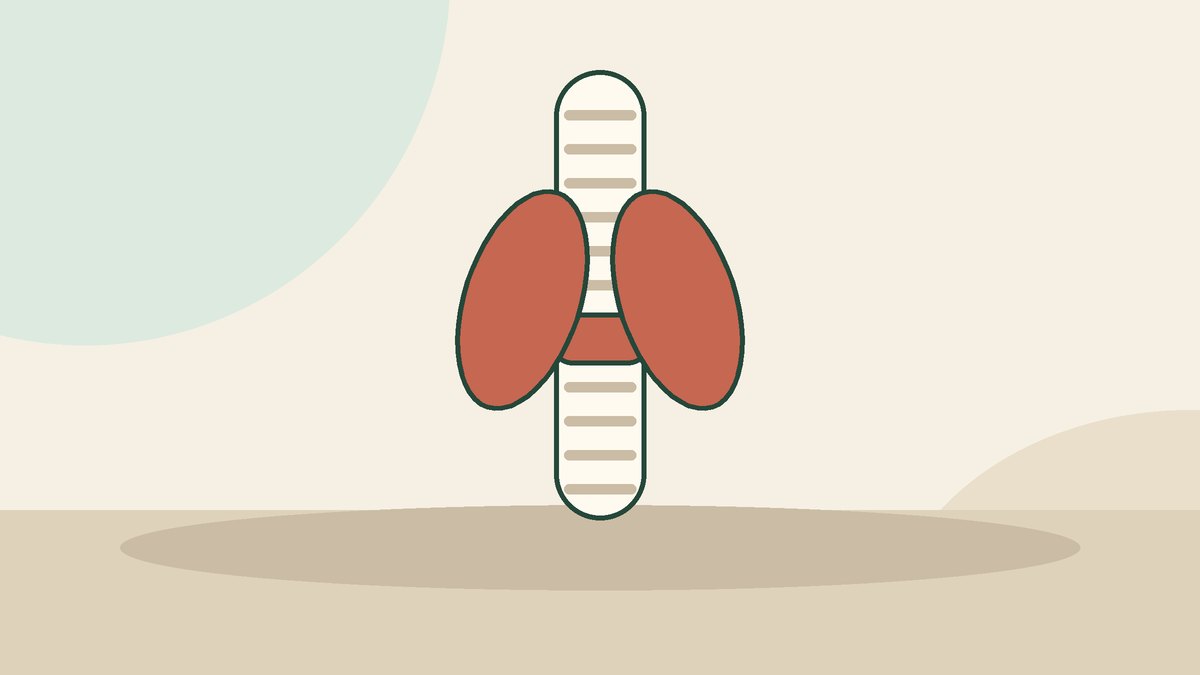
The thyroid sits in the front of your neck, below the Adam’s apple and in front of the windpipe. British Association of Endocrine and Thyroid Surgeons (BAETS) describes it as butterfly-shaped, with two halves, the left and right lobes, joined by a central bridge called the isthmus.
- The lobes lie on either side of the windpipe. In healthy adults each is around 3–4 cm tall and 1–2 cm wide, BAETS says.
- The isthmus crosses the front of the windpipe, usually at the level of its 2nd and 3rd cartilage rings, according to StatPearls, a medical reference on the US National Library of Medicine’s bookshelf.
- Weight: about 25 g in an adult.
- Variations are common. A small extra pyramidal lobe rising from the isthmus is found in 28% to 55% of people, and the two lobes are often unequal in size.
Because it sits so close to the windpipe and food pipe, a large goitre can press on them, which is why trouble breathing or swallowing with a neck swelling needs prompt care.
Blood supply of the thyroid gland
The thyroid has a rich blood supply from two pairs of arteries. The superior thyroid artery, the first branch of the external carotid artery in the neck, feeds the upper part of each lobe. The inferior thyroid artery, which comes from a branch of the subclavian artery near the collarbone, feeds the lower part and the back. About 1 in 10 people have a small extra artery, the thyroid ima, that supplies the isthmus. Blood drains through the superior, middle and inferior thyroid veins.
What the thyroid gland does: hormones that set your pace
The thyroid takes iodine from your food and uses it to make thyroid hormones. The American Thyroid Association (ATA) says these hormones travel to every tissue and help the body use energy, stay warm, and keep the brain, heart and muscles working. MedlinePlus adds breathing, heart rate, weight, digestion and mood to the list.
| Hormone | Where it is made | What it does |
|---|---|---|
| Thyroxine (T4) | Thyroid | The main hormone the gland releases; much of it is later converted into the active form |
| Triiodothyronine (T3) | Thyroid, and from T4 in other tissues | The active form that acts on cells; the ATA says most T3 comes from T4 |
| Thyroid-stimulating hormone (TSH) | Pituitary gland, at the base of the brain | Tells the thyroid how much hormone to make |
| Calcitonin | Special C cells inside the thyroid | Has a role in blood calcium; not part of a routine thyroid test |
What is TSH? It works like a thermostat signal. MedlinePlus explains that when thyroid hormone in the blood falls, the pituitary makes more TSH to push the thyroid harder; when hormone is too high, it makes little or none. That is why a high TSH usually points to an underactive thyroid and a low TSH to an overactive one, and why TSH is often the first test. Our guide to reading TSH, T3 and T4 results covers the numbers.
Thyroid and parathyroid: two different glands
The parathyroids are separate glands with a similar name. National Institute of Diabetes and Digestive and Kidney Diseases (NIDDK) describes them as four pea-sized glands on or near the thyroid in the neck, usually behind it, and says plainly that the two are not related.
- Job: they make parathyroid hormone (PTH), which keeps blood calcium in balance by drawing calcium from bone, helping the gut absorb it and helping the kidneys hold on to it.
- Problems look different. An overactive parathyroid raises blood calcium and can weaken bones or cause kidney stones; most people have no symptoms, and it is usually found on a routine calcium test.
- Tests differ. Parathyroid problems are checked with calcium and PTH, not TSH, so a normal thyroid report says nothing about them.
Because the parathyroids sit so close, BAETS lists calcium and parathyroid hormone among the blood tests a surgeon may check before thyroid surgery. In Marathi, the Marathi Vishwakosh calls them paravatu granthi.
Why thyroid problems happen
If you are asking “thyroid kyu hota hai”, these are the main causes, briefly. Most are not something you brought on yourself.
- Autoimmunity. The immune system attacks the thyroid by mistake. NIDDK names Hashimoto’s disease as the most common cause of an underactive thyroid and Graves’ disease, where antibodies push the gland to overwork, as the most common cause of an overactive one. In an eight-city Indian study, 21.85% of adults had thyroid antibodies.
- Iodine, too little or too much. The thyroid needs iodine, which is why India decided in 1984 to iodise all edible salt, phased in from 1986, and Indian Council of Medical Research–National Institute of Nutrition (ICMR-NIN) advises “use iodized salt”. Too much can also harm: NIDDK warns that kelp, other seaweed and iodine supplements may cause or worsen thyroid disease in people with autoimmune thyroid problems. Iodised salt protects against deficiency, not against autoimmunity.
- After childbirth. Postpartum thyroiditis is an inflammation of the thyroid after delivery. The ATA says it affects about 5–10% of women in the US; an overactive phase can come 1–4 months after delivery and an underactive phase 4–8 months after. Most women recover within 12–18 months, but about 20% of those with an underactive phase stay that way.
- Medicines and past treatment. The ATA lists lithium, amiodarone and certain cancer medicines as able to affect the thyroid. Thyroid surgery, radioactive iodine and radiation to the neck can also leave it underactive. Do not stop any of these medicines because of this; ask the prescribing doctor whether thyroid tests are needed.
- Family history and other conditions. NIDDK says you are more likely to develop thyroid disease if it runs in your family, or if you have type 1 or type 2 diabetes, pernicious anaemia or another autoimmune condition. Risk also rises after age 60.
Less often, thyroiditis follows a viral infection, or a pituitary problem disturbs the TSH signal. Our guide to the types of thyroid problems goes through each condition and its cause.
Why thyroid problems are more common in women in India
Women are affected far more often than men. In a 2011 study of 5,360 urban adults in eight Indian cities, 15.86% of women had hypothyroidism against 5.02% of men, and thyroid antibodies were found in 26.04% of women and 16.81% of men. Rates were highest at ages 46 to 54.
One clear reason is that autoimmune thyroid disease, the commonest cause, is more frequent in women, as the ATA notes. Pregnancy adds its own risk through postpartum thyroiditis. The study tested only city adults at health camps and was funded by a thyroid-medicine maker, so treat its figures as a strong signal rather than a national count. Our guide to thyroid symptoms in women covers periods, pregnancy and menopause.
Thyroid in Hindi, Marathi and Kannada
In all three languages, most people simply say “thyroid”. Dictionaries also give formal words:
| Language | Formal or dictionary word | Where it comes from |
|---|---|---|
| Hindi | Avatu granthi (also galgranthi) | Hindi WordNet at the Indian Institute of Technology Bombay, which defines it as an endocrine gland at the base of the neck, on both sides of the lower voice box and upper windpipe |
| Marathi | Avatu granthi (also dhalgranthi, “shield gland”) | Maharashtra government’s anatomy glossary and the Marathi Vishwakosh |
| Kannada | Thyroid granthi | Amarkosh online Kannada dictionary |
“Granthi” means gland. According to the Marathi Vishwakosh, “avatu” is the name of a cartilage of the voice box (the thyroid cartilage), and the gland’s two lobes lie on either side of it. Do not confuse these with “galgand”, a common word for goitre, which is a swollen thyroid rather than the gland itself.
When to see a doctor
Our thyroid guide has the full list of thyroid warning signs.
Emergency: get help now (call 112)
- Difficulty breathing, or noisy breathing, with a neck swelling.
- A racing heart with high fever, confusion or fainting, or palpitations with chest pain.
- Severe drowsiness or confusion in someone with a severe or untreated underactive thyroid.
Prompt review: within days to a few weeks
- A neck lump that is new or growing, or a swelling with a hoarse voice or trouble swallowing.
- Bulging, red or painful eyes, or double vision.
- You are pregnant or planning a pregnancy and already have a thyroid condition: NIDDK notes that many women need a higher dose of thyroid medicine in pregnancy.
Routine review: book a test
- Lasting tiredness, unexplained weight change, feeling unusually cold or hot, or changed periods.
- A close relative has a thyroid disorder and you have symptoms, or you had thyroid problems after a previous delivery.
Not sure who to see? Our guide to which doctor to see for thyroid problems explains when a general physician is enough.
How Disha can help
Disha is an AI health coach that chats and calls in Hindi, English and Hinglish. It does not replace your doctor, and it does not diagnose, prescribe or provide emergency care. If you have just been told you “have thyroid”, it can help you note your questions for the doctor, keep track of test dates, and build food, movement and sleep routines around the plan your doctor gives you. Its onboarding call of about 15–20 minutes is conducted by Disha, the AI; no human doctor is on the call. Read how Disha coaching works.
This is not medical advice. This page is general information for adults (18+), not a diagnosis. Only a blood test, read by a doctor, can show whether your thyroid is working normally. Do not start, stop or change any medicine, including thyroid tablets, because of what you read here. In an emergency, call 112.
Frequently asked questions
What does the thyroid gland do, in simple words?
It sets the pace of your body. The thyroid uses iodine from food to make hormones, mainly thyroxine (T4), that reach every tissue and control how fast you use energy. They affect your heart rate, temperature, digestion, weight, mood and periods. Too little hormone slows things down; too much speeds them up. The pituitary gland in the brain controls the thyroid through TSH.
Is thyroid a disease?
No. The thyroid is a normal gland that everyone has. When people say “I have thyroid”, they mean a thyroid disorder, most often an underactive thyroid (hypothyroidism), sometimes an overactive one (hyperthyroidism), a goitre or nodules. These are different conditions with different treatments, so it is worth asking your doctor exactly which one you have and what caused it.
What is TSH, and why is it tested first?
TSH, thyroid-stimulating hormone, is made by the pituitary gland and tells the thyroid how hard to work. When thyroid hormone falls, TSH rises; when it is too high, TSH falls. Because it shows how the pituitary reads your hormone level, it is usually the first test. MedlinePlus notes that TSH alone cannot show the cause, so doctors often add free T4 or antibody tests. Our guide to the TSH normal range explains the numbers.
What is the thyroid meaning in Marathi?
The formal Marathi word is avatu granthi, as listed in the Maharashtra government’s anatomy glossary. The Marathi Vishwakosh also calls it dhalgranthi, or shield gland, after its shape, and names the parathyroids paravatu granthi. In everyday Marathi, as in Hindi, most people simply say “thyroid”, and “thyroid aahe” usually means a thyroid disorder rather than the gland.
Is thyroid dangerous?
The gland is not; untreated thyroid disease can be. NIDDK says an untreated overactive thyroid can cause an irregular heartbeat, stroke and thinning bones, and an underactive one can raise cholesterol and, rarely, cause a life-threatening slowdown called myxoedema coma. For an underactive thyroid, the ATA says that with the right dose you can live a normal, healthy life. NIDDK adds that thyroid nodules are common and usually not cancerous.
Can you live without a thyroid gland?
Yes. Some people have the whole thyroid removed for a goitre, nodules, cancer or an overactive gland. NIDDK says removing the entire thyroid always causes hypothyroidism, so a daily thyroid hormone tablet is needed for life, with the dose checked by blood tests. With the right dose, daily life is normal. Never stop that tablet without your doctor.
Do thyroid problems go away on their own?
Some do. Thyroiditis after a virus or a delivery often settles within months, though about 20% of women with an underactive phase after childbirth stay underactive. The ATA says most people with an underactive thyroid take medicine for life. An overactive thyroid can be controlled with medicines, radioactive iodine or surgery. Our guide on whether thyroid can be cured explains each type.
Sources
- Allen E, Fingeret A. Anatomy, Head and Neck, Thyroid. StatPearls (NCBI Bookshelf), last updated 2025. Supports: two lobes joined by the isthmus at the 2nd and 3rd tracheal rings; position below the thyroid cartilage; weight about 25 g; thyroid hormone and calcitonin; superior thyroid artery from the external carotid and inferior thyroid artery from the thyrocervical trunk of the subclavian; thyroid ima artery in about 10%; superior, middle and inferior thyroid veins; pyramidal lobe in 28% to 55% and unequal lobes; closeness to the parathyroid glands.
- British Association of Endocrine and Thyroid Surgeons. Patient Information Leaflet T1: Thyroid Operations in Adults. Updated 2024. Supports: butterfly shape in front of the windpipe below the Adam’s apple; two lobes joined by the isthmus; lobes about 3–4 cm tall and 1–2 cm wide; weight about 25 g; goitre pressing on the windpipe or gullet; calcium and parathyroid hormone among pre-operative blood tests; lifelong tablets after total thyroidectomy.
- American Thyroid Association. Hypothyroidism and Postpartum Thyroiditis. Current patient brochures. Supports: butterfly-shaped gland in the lower front of the neck; hormones reaching every tissue and helping the body use energy and stay warm; most T3 made from T4; autoimmune disease more common in women; lithium, amiodarone and certain cancer drugs; surgery, radiation and iodine as causes; normal life with the right dose; thyroiditis after a virus or pregnancy may go away; postpartum thyroiditis in about 5–10% of women, phase timing, recovery in 12–18 months and about 20% staying hypothyroid.
- National Institute of Diabetes and Digestive and Kidney Diseases. Hypothyroidism (reviewed 2021), Hyperthyroidism (reviewed 2021) and Primary Hyperparathyroidism (reviewed 2019). Supports: Hashimoto’s and Graves’ disease as the most common causes; family history, diabetes, pernicious anaemia, autoimmune conditions, recent pregnancy and age over 60 as risk factors; iodine-rich seaweed and supplements in autoimmune thyroid disease; higher doses in pregnancy; complications including irregular heartbeat, stroke, bone thinning, high cholesterol and myxoedema coma; lifelong treatment after total thyroid removal; nodules common and usually not cancerous; four pea-sized parathyroid glands, PTH and calcium, not related to the thyroid, usually found on routine tests.
- MedlinePlus (US National Library of Medicine). TSH (Thyroid-stimulating hormone) Test and Thyroid Diseases. Current medical information. Supports: thyroid hormones affecting breathing, heart rate, weight, digestion and mood; the pituitary making TSH and raising or lowering it in response to thyroid hormone; TSH not showing the cause; thyroid diseases including goitre, nodules and thyroiditis.
- Unnikrishnan AG, Kalra S, Sahay RK, Bantwal G, John M, Tewari N. Prevalence of hypothyroidism in adults: An epidemiological study in eight cities of India. Indian Journal of Endocrinology and Metabolism, 2013. Observational study. Supports: 5,360 urban adults tested in 2011 at health camps; hypothyroidism in 15.86% of women and 5.02% of men; highest rates at ages 46 to 54; thyroid antibodies in 21.85% overall, 26.04% of women and 16.81% of men; urban-only limitation and funding by Abbott India.
- Press Information Bureau, Ministry of Health and Family Welfare. World Iodine Deficiency Day. October 2024. Supports: the 1984 policy decision to iodise all edible salt in India, phased from 1986.
- ICMR–National Institute of Nutrition. Dietary Guidelines for Indians. 2024. Supports: “use iodized salt”, including in pregnancy.
- Language references: Centre for Indian Language Technology, IIT Bombay, Hindi Shabdamitra: avatu granthi; Government of Maharashtra, Sharir Paribhasha Kosh (anatomy glossary) and Marathi Vishwakosh: Avatu granthi; Amarkosh, Kannada dictionary: thyroid. Supports: avatu granthi and galgranthi in Hindi; avatu granthi, dhalgranthi and paravatu granthi in Marathi; avatu as the neck cartilage beside which the lobes lie; thyroid granthi in Kannada.
Related reads
- Thyroid disorders in India: symptoms, tests, treatment and daily care: the overview this page sits under, with diagnosis, treatment and the full red-flag list.
- Types of thyroid problems: hypothyroidism, hyperthyroidism, goitre, nodules and thyroiditis, one by one.
- Thyroid symptoms: early signs of an underactive or overactive thyroid and when to get tested.
- TSH, T3 and T4: how to read your thyroid report: each line of the report and why your lab’s range applies.
- All thyroid articles: every Disha guide on thyroid in one place.
- BMI calculator with Indian cut-offs: a screening number if weight change is part of your worry.