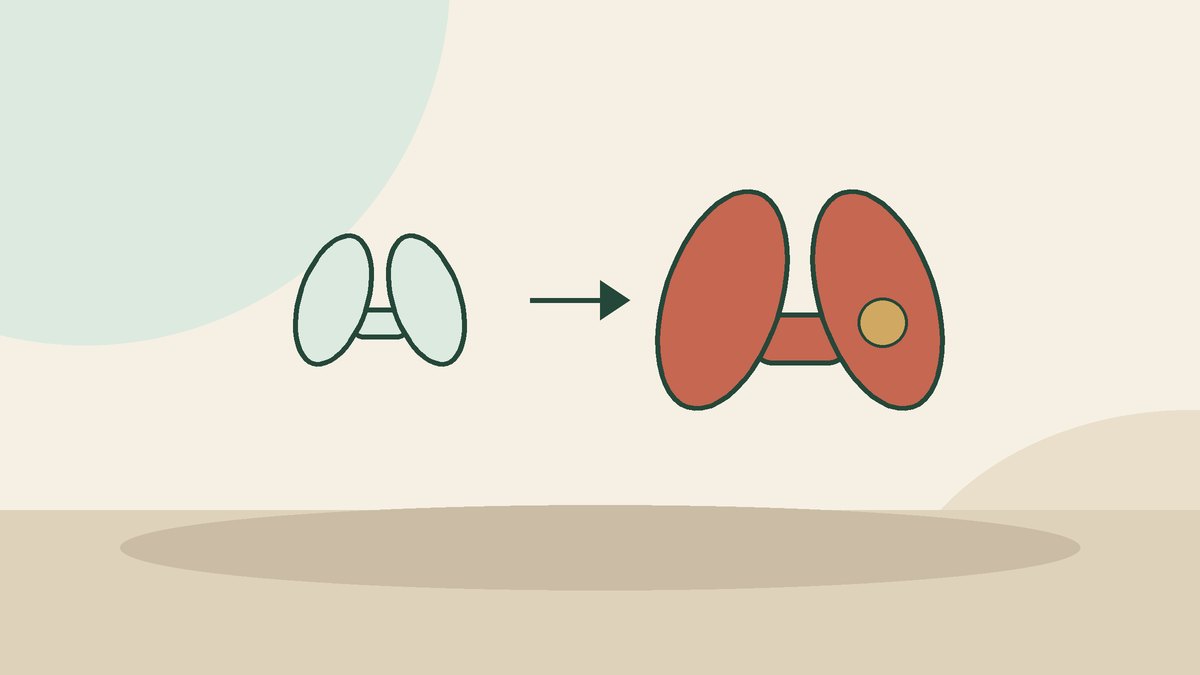
Maybe you noticed a fullness at the base of your neck in a photo, or a relative said “galgand”. You search “thyroid se gale mein sujan” and find frightening pictures. An enlarged thyroid, also called a goitre (ghegha in Hindi), is common, usually not cancer, and its cause can usually be found with simple tests.
For the wider picture of thyroid disorders, see our thyroid guide on symptoms, tests and treatment.
Normal neck vs enlarged thyroid: how to look in the mirror
The thyroid is a butterfly-shaped gland in the lower front of the neck, below the voice box and above the collarbones. A normal gland is small: StatPearls, a medical reference, gives a volume of about 7–10 mL on ultrasound. National Health Service (NHS) describes a goitre as a usually painless swelling there, smooth or lumpy, sometimes on one side only.
The American Association of Clinical Endocrinology (AACE) suggests a simple neck check with a hand mirror and a glass of water:
- Hold the mirror so you can see the lower front of your neck, above the collarbones and below the voice box.
- Tip your head back, take a sip of water and swallow.
- As you swallow, watch for any bulge in that area. Repeat a few times.
- Do not mistake the Adam’s apple for the thyroid; the thyroid sits lower, closer to the collarbone.
The thyroid moves up as you swallow, which is why the water helps. If you see a bulge, AACE advises seeing a doctor. This check is not a diagnosis: AACE notes that many thyroid conditions, including some nodules, cannot be seen this way. A normal mirror check does not rule out a thyroid problem, and a bulge does not mean cancer.
| What you notice | What it may mean | What to do |
|---|---|---|
| Nothing visible, but tiredness, weight change or a racing heart | Hormone problems often happen without any swelling | Ask about a TSH blood test, not a scan |
| An even fullness on both sides that moves on swallowing | A diffuse goitre: low iodine, Hashimoto’s thyroiditis, Graves’ disease, or puberty or pregnancy changes | Routine appointment, with a TSH test |
| A single lump on one side | Often a nodule; most are not cancer | Routine appointment; ultrasound is usually next |
| A lump that grows fast, feels hard and fixed, or comes with a hoarse voice or trouble swallowing | Needs checking for pressure on the neck or, less often, cancer | See a doctor within days |
| Any neck swelling with difficulty breathing or a wheezing noise | The swelling may be pressing on the windpipe | Emergency: call 112 |
Why the thyroid swells: causes, and iodine in India
A goitre is a sign that something is making the gland grow. The American Thyroid Association (ATA) and NHS list these causes:
- Too little iodine. The thyroid needs iodine to make hormone. With too little, the pituitary sends more TSH, which makes the gland grow. The ATA calls this one of the most common causes worldwide.
- Hashimoto’s thyroiditis. The immune system damages the gland, and the extra TSH that follows can enlarge it.
- Graves’ disease. An antibody makes the thyroid grow and overproduce hormone.
- Nodules and multinodular goitre, often with normal hormone levels; the ATA says the cause of this type is not well understood.
- Thyroiditis (inflammation), for example after a viral illness or a pregnancy.
- Hormone changes during puberty, pregnancy or menopause.
- Thyroid cancer, which NHS describes as rare.
India’s salt iodisation programme
India started the National Goitre Control Programme (NGCP) in 1962 and renamed it the National Iodine Deficiency Disorders Control Programme (NIDDCP) in August 1992. Its goals are iodine deficiency disorders in under 5% of people and every household using adequately iodised salt, meaning at least 15 parts per million (ppm) of iodine.
Earlier district surveys found iodine deficiency disorders in more than 5% of people in 348 of 427 districts surveyed. Coverage has since improved a lot: the Directorate General of Health Services (DGHS) reports that 94.3% of households used adequately iodised salt in 2020–21, according to the National Family Health Survey (NFHS), and that 93.3% of salt samples tested from April to December 2024 were adequately iodised.
For you, this means checking that your everyday cooking salt says “iodised”, and keeping sendha or rock salt for fasting days. Gobhi and soya are not the main problem; our guide to goitrogens in Indian cooking explains why iodine matters more. Iodised salt helps prevent iodine-deficiency goitre, but it cannot treat a goitre from Hashimoto’s, Graves’ disease or nodules. Do not start iodine or kelp capsules on your own: too much iodine can also cause thyroid problems.
Swollen thyroid in females: why women are affected more often
Women get goitres and nodules far more often than men. StatPearls states that females are about four times more likely to develop a goitre, and the ATA’s 2015 guideline puts palpable thyroid nodules at about 5% of women and 1% of men in iodine-sufficient regions.
Pregnancy can enlarge the thyroid slightly. The ATA says ultrasound can detect a rise in thyroid volume in some pregnant women, usually only 10–15%, not typically visible on examination; noticeable pregnancy goitres are much more frequent where iodine intake is low. The Indian Thyroid Society notes that pregnancy is associated with growth of existing nodules and of new ones.
If you notice a neck lump while pregnant, tell your obstetrician. For a palpable nodule in pregnancy, the Indian Thyroid Society advises a TSH test, a neck ultrasound and fine needle aspiration cytology (FNAC). Radioactive scans are not done in pregnancy or while breastfeeding. Our guide to thyroid symptoms in women covers periods, pregnancy and menopause.
Thyroid nodules: most are harmless, but each needs a look
A thyroid nodule is a lump formed by an abnormal growth of thyroid cells. The ATA says about half of all people have one by age 60, found by examination or imaging, and over 90% of these are benign (not cancer).
Most nodules cause no symptoms and are found by chance. The ATA adds that thyroid blood tests are usually normal even when a nodule contains cancer, so a nodule is judged mainly on ultrasound.
When a needle test is suggested. The ATA’s 2015 guideline bases the decision on how the nodule looks on ultrasound and how big it is. The more suspicious the pattern (for example, a solid, dark nodule with irregular edges or tiny calcium specks), the smaller the size at which a biopsy is recommended; the guideline recommends a needle biopsy (FNA) for “Nodules ≥1 cm in greatest dimension with high suspicion sonographic pattern”. Purely fluid-filled cysts need no biopsy, and for very low-suspicion, sponge-like nodules, watching is “a reasonable option”. An updated ATA nodule guideline has been in preparation, and your report may use another established grading system, as National Institute for Health and Care Excellence (NICE) asks.
Benign nodules usually do not need removal unless they cause symptoms such as choking or difficulty swallowing, but the ATA advises follow-up ultrasound in case one grows or changes.
Thyroid scan, ultrasound or FNAC: which test does what
The usual order is a TSH blood test, then an ultrasound, then other tests only if needed. In India, “scan” is often used loosely for an ultrasound (our observation), so ask which is meant: a neck ultrasound (often written “USG”) or a radioactive iodine scan.
| Test | What it shows | Who usually needs it | What to expect |
|---|---|---|---|
| TSH blood test, with free thyroxine (T4) if TSH is abnormal | Whether the thyroid is underactive, overactive or normal | Everyone with a goitre or nodule, first | A routine blood sample; a normal result does not rule out a cancerous nodule |
| Thyroid ultrasound | Gland size, and the size and appearance of nodules and nearby lymph nodes | The ATA says everyone with a known or suspected nodule | Painless; shows structure, not hormone levels |
| Radioactive iodine uptake and scan | How much iodine the gland takes up, and whether a nodule is “hot” (overactive) or “cold” | Mainly when TSH is low | A small radioactive pill, then readings hours later and at 24 hours; not in pregnancy or breastfeeding |
| FNAC | Cells from the nodule, examined under a microscope | Nodules that meet ultrasound size and pattern criteria | A very thin needle, guided by ultrasound; often done in a clinic |
| Computed tomography (CT) | How far a large goitre extends and whether it narrows the windpipe | A large goitre with pressure symptoms | Not routine for small goitres or nodules |
A radioactive scan is not a first test for most nodules. The ATA’s guideline says a radionuclide scan should be done if TSH is below normal, and should not be the first imaging test if TSH is normal or high. Overactive “hot” nodules rarely contain cancer, so a scan can sometimes spare a biopsy. NICE recommends doing FNAC with ultrasound guidance.
Before a radioactive iodine scan, MedlinePlus advises mentioning iodine-containing medicines or supplements such as kelp, and any CT contrast dye in the last two weeks. Before FNAC, mention blood thinners, but do not stop them unless the prescribing doctor agrees. For costs, see our guide to thyroid test prices.
Reading an FNAC report
Reports use six Bethesda categories, from non-diagnostic to malignant. The ATA says up to 80% of biopsies come back benign, and a benign result misses a cancer generally less than 3% of the time. An “indeterminate” result may lead to a repeat test, molecular testing or surgery, decided with your doctor.
Can a goitre go away, and when is surgery needed?
It depends on the cause. The ATA describes what usually happens:
- Iodine deficiency: iodine given under medical care shrinks the goitre, but often not completely.
- Hashimoto’s with an underactive thyroid: a daily thyroid hormone tablet restores hormone levels; the goitre may get smaller and usually stops growing, but rarely vanishes.
- Graves’ disease: treatment, for example with radioactive iodine, usually shrinks or removes the goitre.
- Multinodular goitre with normal hormone levels: usually no specific treatment, only monitoring.
Most goitres do not need surgery. NICE advises against treating adults whose non-cancerous goitre has normal thyroid function and mild or no symptoms, unless there is breathing difficulty or marked narrowing of the airway. When a goitre presses on the windpipe or food pipe, options include surgery, radioactive iodine, draining a fluid-filled cyst, or heat treatment (thermal ablation). Surgery is also advised when cancer is found or strongly suspected.
StatPearls notes that giving thyroid hormone tablets just to shrink a goitre is no longer recommended, because it works poorly and can harm the heart and bones. A tablet prescribed for an underactive thyroid is different; never start, stop or change one yourself. We found no trial showing that a diet, kadha or exercise shrinks a goitre or nodule; food and activity support your general health while your doctor treats the cause.
The ATA advises regular, usually yearly, monitoring once a goitre is diagnosed. Our guide to types of thyroid problems shows how goitre fits with an underactive or overactive thyroid and thyroiditis.
When to see a doctor
Our hub has the full list of thyroid warning signs.
Emergency: get help now (call 112)
- Difficulty breathing, or a wheezing or high-pitched noise when you breathe, with a neck swelling. Do not drive yourself.
Prompt review: within days to a few weeks
- A neck lump that is growing quickly.
- A lump that feels hard or fixed, or swollen glands on the side of the neck.
- A hoarse or changed voice, trouble swallowing, a lasting cough or a feeling that something is stuck in your throat.
- A swelling in the thyroid area that suddenly becomes painful or tender.
- A neck lump during pregnancy, or a lump with a family history of thyroid cancer or past radiation to the head or neck.
Routine review
Book an appointment for any new neck swelling or lump, even without symptoms, and for yearly follow-up of a known goitre or nodule. A physician can start the assessment; our guide on which thyroid doctor to see explains when an endocrinologist, ENT specialist or surgeon is needed.
How Disha can help
Disha is an AI health coach that chats and calls in Hindi, English and Hinglish. It does not examine a lump, read your reports, diagnose or prescribe, and it does not replace your doctor or provide emergency care. After an onboarding call of about 15–20 minutes with Disha, the AI, it helps with daily habits around your care: meals cooked with iodised salt, movement and sleep. Read how Disha coaching works.
This is not medical advice. This page is general education for adults (18+), not a diagnosis or treatment plan. Do not start, stop or change any medicine or supplement, including iodine, because of it. If you are pregnant, planning a pregnancy or breastfeeding, tell your doctor before any radioactive scan. In an emergency, call 112.
Frequently asked questions
Is a swollen thyroid dangerous?
Usually not. NHS says goitres are not usually serious, and the ATA says over 90% of thyroid nodules are benign. A goitre still needs checking, because it can come with an underactive or overactive thyroid, and a few nodules are cancer. It becomes urgent if it grows fast, feels hard, changes your voice, or makes swallowing or breathing difficult; trouble breathing is an emergency.
Can a goitre go away on its own?
Sometimes. A goitre from thyroiditis often settles as the inflammation clears, and StatPearls notes that some goitres shrink over time without treatment. Many others stay the same or grow slowly. Treating the cause, such as an overactive thyroid, can shrink it, while goitres from Hashimoto’s often get smaller without disappearing. Yearly monitoring shows which way yours is going.
Does a goitre need surgery?
Most do not. NICE advises against treating a non-cancerous goitre with normal thyroid function and mild or no symptoms, unless it affects breathing or clearly narrows the airway. Surgery is considered when a goitre presses on the windpipe or food pipe, when cancer is found or suspected, or sometimes for appearance. Radioactive iodine and thermal ablation are other options a specialist may discuss.
Is a thyroid scan painful?
No. An ultrasound is painless: gel and a probe on your neck. For a radioactive iodine uptake test, MedlinePlus says there is no discomfort; you swallow a pill and lie still under a scanner, which some people find tiresome. FNAC uses a very thin needle, and the ATA says local anaesthetic may not even be needed. People usually go home or back to work afterwards.
What is a thyroid nodule?
A nodule is a lump inside the thyroid formed by an abnormal growth of thyroid cells. It can be solid, fluid-filled (a cyst) or mixed. Nodules are very common, especially in women and older adults, and the great majority are benign. Most cause no symptoms. An ultrasound decides whether a nodule needs a needle test or just periodic follow-up.
What is the ICD-10 code for a thyroid nodule?
In the World Health Organization (WHO) version of the International Classification of Diseases (ICD-10), E04.1 is “Nontoxic single thyroid nodule”. Related codes are E04.0 “Nontoxic diffuse goitre”, E04.2 “Nontoxic multinodular goitre” and E04.9 “Nontoxic goitre, unspecified”. Overactive (toxic) nodules are coded under E05, and iodine-deficiency goitre under E01. Your doctor or hospital chooses the code from the actual diagnosis.
Can I check my thyroid at home?
You can look for a visible bulge with the AACE neck check: a mirror, a sip of water, and watching the lower front of your neck as you swallow. It can only spot visible swelling; it cannot tell you your hormone levels or whether a lump is harmless. If you see a bulge, or have symptoms without one, see a doctor for an examination and a TSH test.
Sources
- NHS. Goitre. Page last reviewed 11 March 2026. Supports: goitre as a usually painless swelling at the lower front of the neck, smooth or lumpy, sometimes on one side; cough, hoarse voice, feeling of something stuck, wheezing and difficulty swallowing or breathing; emergency care for breathing difficulty and not driving yourself; goitres not usually serious; tests (blood tests, ultrasound, needle biopsy); surgery when breathing or swallowing is affected; causes including puberty, pregnancy and menopause, and rare cancer.
- American Thyroid Association. Goiter, Thyroid Nodules and Hypothyroidism in Pregnancy. Current patient pages. Supports: goitre with high, low or normal hormone; iodine deficiency, Hashimoto’s, Graves’ disease and multinodular goitre as causes; treatment by cause and how far each goitre shrinks; yearly monitoring; nodules in about half of people by 60, over 90% benign; normal blood tests even with cancer; ultrasound painless; FNA needle very small, local anaesthetic may not be needed, blood thinners; benign results in up to 80% and under 3% missed cancer; indeterminate results; follow-up ultrasound; 10–15% thyroid growth in pregnancy and goitres more frequent with iodine deficiency.
- Haugen BR, Alexander EK, Bible KC, Doherty GM, Mandel SJ, Nikiforov YE, et al. 2015 American Thyroid Association Management Guidelines for Adult Patients with Thyroid Nodules and Differentiated Thyroid Cancer. Thyroid, 2016. Guideline. Supports: palpable nodules in about 5% of women and 1% of men; TSH first, radionuclide scan if TSH is subnormal and not first if TSH is normal or high; hot nodules rarely malignant; ultrasound for all known or suspected nodules; FNA by ultrasound pattern and size, including the quoted high-suspicion criterion, no biopsy for purely cystic nodules and observation as an option for very low-suspicion nodules; Bethesda categories; rapid growth, hoarseness, fixation and lymph nodes as warning features.
- National Institute for Health and Care Excellence (NICE). Thyroid disease: assessment and management (NG145). 2019, updated 2023. Supports: goitre and nodules common and usually not cancerous; red flags of breathlessness, rapid growth, hoarse voice and swallowing difficulty; ultrasound grading and ultrasound-guided FNAC; no treatment for non-malignant enlargement with normal function and mild or no symptoms unless breathing difficulty or marked airway narrowing; surgery, radioactive iodine, thermal ablation and cyst aspiration for compressive symptoms.
- American Association of Clinical Endocrinology. How to Check Your Thyroid. Current patient page. Supports: the mirror-and-water neck check steps; not confusing the Adam’s apple with the thyroid; seeing a doctor for any bulge; the check being only a visual inspection that can miss many conditions, including some nodules.
- MedlinePlus Medical Encyclopedia, US National Library of Medicine. Thyroid scan and Radioactive iodine uptake. Reviewed January 2026. Supports: the radioactive pill and readings at 4 to 6 and 24 hours; hot and cold nodules; fasting; telling the provider about iodine-containing medicines, kelp and contrast within 2 weeks; no discomfort with the uptake test and discomfort from lying still during the scan; no scan in pregnancy or breastfeeding.
- Can AS, Rehman A. Goiter. StatPearls, NCBI Bookshelf. Last updated August 2023. Supports: normal thyroid volume of 7 to 10 mL on ultrasound; females about four times more likely to develop goitre; Hashimoto’s as an important cause where salt is iodised; swallowing during examination; CT for suspected compression; some goitres regressing over time; thyroid hormone suppressive therapy no longer recommended.
- Directorate General of Health Services, Ministry of Health and Family Welfare. National Iodine Deficiency Disorders Control Programme (NIDDCP), last updated April 2025, and National Centre for Disease Control. Training of Laboratory Technicians under NIDDCP. Supports: NGCP in 1962 and renaming in August 1992; goals of under 5% prevalence and 100% household use of salt with 15 ppm iodine; 94.3% of households in 2020–21 per NFHS; 93.3% of samples adequately iodised in April–December 2024; 348 of 427 surveyed districts endemic; Food Safety and Standards regulation restricting sale of non-iodised salt.
- Indian Thyroid Society. Guidelines for Management of Thyroid Dysfunction During Pregnancy. Undated. Supports: growth of existing and new nodules in pregnancy; TSH, neck ultrasound and FNAC for a palpable nodule in pregnancy; radioiodine scanning contraindicated in pregnancy and lactation.
- World Health Organization. ICD-10 Version 2019, E04 Other nontoxic goitre. Supports: E04.0 Nontoxic diffuse goitre, E04.1 Nontoxic single thyroid nodule, E04.2 Nontoxic multinodular goitre, E04.9 Nontoxic goitre, unspecified; iodine-deficiency goitre under E01 and toxic nodules under E05.
Related reads
- Thyroid disorders in India: symptoms, tests and treatment: the overview this page sits under. It covers hypothyroidism, hyperthyroidism, treatment and the full warning-sign list; this page goes deeper on goitre and nodules only.
- Types of thyroid problems: how goitre and nodules relate to an underactive or overactive thyroid and thyroiditis.
- Thyroid test price in India: what common thyroid tests cost in Indian labs.
- Which thyroid doctor to see: physician, endocrinologist, ENT specialist or surgeon.
- TSH normal range and how to read your thyroid report: the blood test that comes before any scan.
- All thyroid articles: every Disha thyroid guide in one place.
- BMI calculator with Indian cut-offs: useful if weight change is part of your worry; it says nothing about a neck lump.