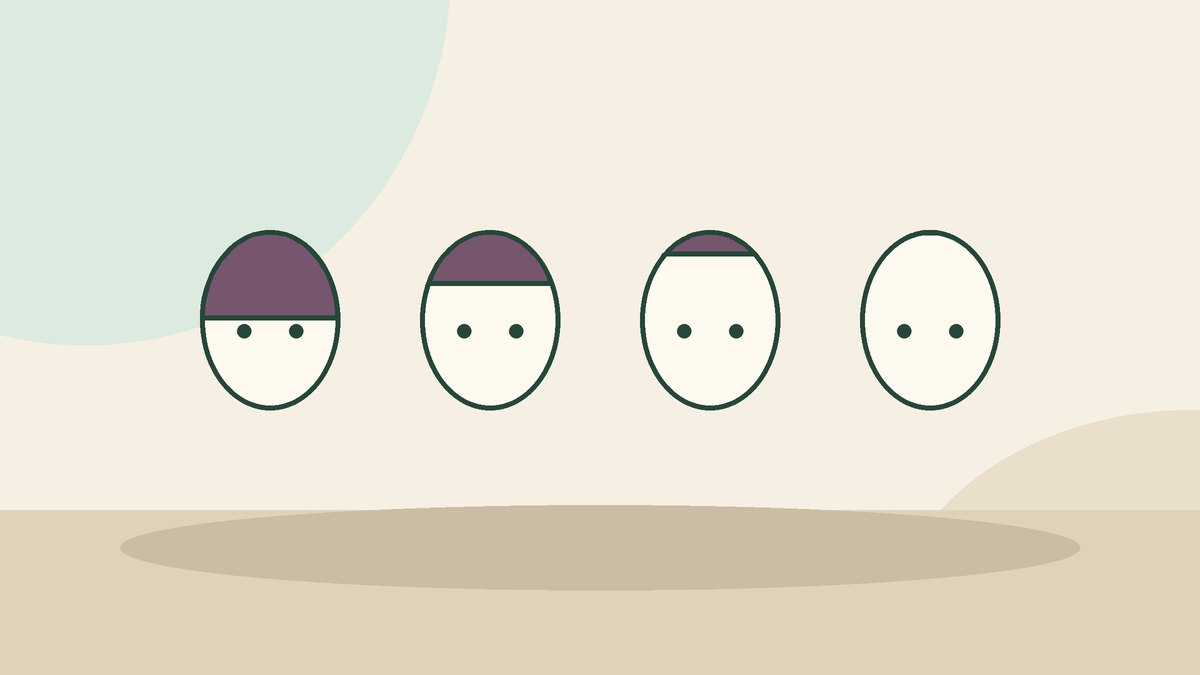
A thinner crown in a photo, a parting that looks wider than last year, or a hairline your barber comments on: the stages of hair loss are how doctors put a number on these changes. Many people search for them as “ganjapan kis stage par hai”, wanting to know how far it has gone and what can still be done.
For causes, tests and treatment of every type of hair loss, see our complete guide to hair loss in India.
Stages of hair loss: what the scales measure, and what they do not
Staging scales describe inherited pattern hair loss, the slow thinning that runs in families and is the most common cause of hair loss worldwide, according to the American Academy of Dermatology (AAD). A 2016 Indian review of these scales notes that the Hamilton-Norwood scale for men and the Ludwig scale for women are the ones most commonly used.
- They measure pattern, not cause. Shedding after fever or childbirth, alopecia areata patches and hair loss from tight hairstyles are not staged on these scales.
- They are not a timetable. A stage tells you where you are, not how fast you will move to the next one.
- Women can follow either pattern. Most women thin over the crown; a male-type pattern in women is uncommon, and Ludwig called it exceptional.
Balding in men: the seven Norwood stages
The Norwood scale, a 1975 revision of Hamilton’s earlier system, grades male pattern hair loss from stage I to VII. The review describes it as the most widely used classification for men.
| Stage | What it looks like | What it usually means |
|---|---|---|
| I | Little or no recession of the hairline | No significant hair loss |
| II | Small, usually even triangles of recession at the temples | Often called an adult or mature hairline; not counted as baldness |
| III | Deep recession at both temples, bare or sparsely covered; in “III vertex”, loss mainly on the crown | The first stage Norwood counted as baldness |
| IV | Deeper temple recession plus a thin or bare crown, separated by a band of hair | Clearly visible pattern loss |
| V | Both bald areas larger; the band between them narrower and sparser | Advanced pattern loss |
| VI | The band has gone; front and crown bald areas have joined | Advanced pattern loss |
| VII | Only a horseshoe of often fine hair remains at the sides and back | The most extensive stage |
What Indian men show. In a population study of 1,005 men aged 30 to 50 in Bengaluru, 58% had pattern hair loss. Stage II was the commonest (27%), then stage I (22%) and stage III (22%). The authors estimated that 44.1% were at stages I to III and 12.9% at stages IV to VI.
Stages of hair loss in women: Ludwig grades and the widening parting
Women usually keep their front hairline and thin over the top of the head instead. Ludwig’s scale, published in 1977 after studying 468 women, has three grades.
| Grade | What it looks like |
|---|---|
| Ludwig I | Thinning you can see on the crown, starting 1–3 cm behind the front hairline |
| Ludwig II | Pronounced thinning over the same area, hard to hide with hairstyling |
| Ludwig III | Full baldness over that area, with a fringe of hair still kept at the front |
Two other descriptions help in daily life. Olsen described a “Christmas tree” pattern: when hair is parted in the middle, thinning is widest at the front and narrows towards the crown. Sinclair’s five-point scale uses photographs of a centre parting, from 1 (normal) to 5 (most severe); women can compare their own parting with the pictures.
Full baldness is uncommon in women. In Ludwig’s original description, the crown became bald in some women, “usually not before the menopause”.
What your stage means for treatment
The earlier treatment starts, the better it works, says AAD; without treatment, pattern hair loss continues. Treatment can slow loss and help some regrowth, but AAD notes that a scalp medicine “cannot regrow an entire head of hair”, and results usually take 6 to 12 months to show. The UK National Health Service (NHS) adds that treatments only work for as long as they are used and none is 100% effective.
- Early stages (Norwood I–III, Ludwig I). A doctor may discuss a scalp medicine, and for men, tablets that block a hormone’s effect on follicles. The Bengaluru authors saw these stages as the group for medical treatment.
- Later stages (Norwood IV–VII, Ludwig II–III). AAD says a dermatologist may still be able to prevent further loss. A hair transplant moves hair from the back of the head to thinning areas; AAD calls it an option for pattern baldness that can give permanent results. It is surgery, so confirm the diagnosis first and choose a qualified surgeon.
Your stage is one input. A doctor also weighs your age, how fast it is changing, your health and, for women, pregnancy plans. Never start, stop or switch a medicine because of the stage you think you are at.
Hair loss test: what you can check at home, and what a dermatologist does
At home: photos, not counting
Monthly photos tell you more than counting hairs in the comb. Take them in the same spot, light and hairstyle: the hairline from the front with hair pulled back, the crown from above, and, for women, a centre parting. Compare photos three months apart; day-to-day changes in shedding mislead.
You may see videos of a home pull test. It is hard to grip the right number of hairs, and one pull rarely answers the question, so leave it to the clinic.
At the clinic
AAD says a dermatologist starts by asking how long hair loss has gone on and whether it came on quickly, then looks closely at the scalp, nails and any other area with hair loss.
- Pull test. The doctor gently pulls a small bunch of hair, about 50 to 60 hairs, and counts how many come out. A 2017 study of 181 healthy volunteers set 2 hairs or fewer as normal; washing or brushing before the test made no difference.
- Dermoscopy. A handheld magnifier called a dermatoscope gives the doctor a close look at the scalp and hairs.
- Blood tests if a deficiency, hormone problem or thyroid disease is suspected. Our guide to blood tests for hair fall explains which are useful.
- Scalp biopsy occasionally, when the doctor needs more information about the cause.
AAD notes that more than one cause can be present, such as shedding after a baby together with early pattern loss. Our guide to the reasons for hair fall lists the other causes and their clues.
When to see a doctor
These are the main warning signs; the hub has the full list of hair-loss warning signs.
Emergency: get help now
- A painful, swollen or pus-filled scalp patch with fever or feeling very unwell.
- Thoughts of harming yourself because of distress about your appearance. Call 112, or Tele Mental Health Assistance and Networking Across States (Tele-MANAS), the Government of India’s mental-health helpline, on 14416.
Prompt review: within days to a few weeks
- Round bald patches, or smooth, shiny, itchy or painful areas: these are not pattern loss and need examination.
- Thinning with irregular periods, acne, excess facial hair or a deepening voice.
Routine review
- A hairline or parting that has clearly changed between photos taken months apart, at any stage.
- Before buying a hair-clinic package or booking a transplant, to confirm the diagnosis.
How Disha can help
Disha is an AI health coach that chats and calls in Hindi, English and Hinglish. It can help you keep up the daily habits that support treatment your doctor recommends: meals with enough protein and iron, sleep, movement and managing stress. It does not stage hair loss, diagnose, interpret tests, prescribe or provide emergency care, and it does not replace your doctor. Read how Disha coaching works.
This is not medical advice. This page is general education for adults (18+), not a diagnosis or treatment plan. Comparing yourself with a chart does not diagnose pattern hair loss; a doctor does. Do not start, stop or change any medicine because of this page. In an emergency, call 112.
Frequently asked questions
How many stages of hair loss are there?
It depends on the scale. The Norwood scale for men has seven stages, from no recession (I) to a horseshoe of hair at the sides and back (VII), with a “vertex” variant for crown loss. The Ludwig scale for women has three grades of crown thinning. Sinclair’s photo scale for women has five points. These scales describe inherited pattern hair loss only.
Can early balding be reversed?
Early pattern hair loss can often be slowed, and some people regrow hair with treatment, especially when it starts early. AAD says the earlier treatment begins, the better it works, but no treatment can regrow a full head of hair, and results usually take 6 to 12 months. Benefits last only while treatment continues. A doctor can tell you what is realistic for your stage.
Is a receding hairline in my 20s the start of balding?
Not always. Slight, even recession at the temples (Norwood II) is often called an adult or mature hairline, and Norwood did not count it as baldness. Deep recession at both temples, or a thinning crown, is more likely to be pattern hair loss. Compare photos taken a few months apart; if the hairline keeps moving, or you see crown thinning, see a dermatologist while treatment can work best.
Is there a hair loss test I can do at home?
The most useful home check is a set of monthly photos of your hairline, crown and parting, taken in the same light and compared three months apart. Counting hairs in the comb misleads, because shedding varies from day to day. The pull test is best done by a doctor, who grips about 50 to 60 hairs and counts how many come out; 2 or fewer is normal.
How fast does hair loss move from one stage to the next?
There is no fixed timetable. Pattern hair loss usually progresses over years, and the speed varies from person to person. In a study of Indian men, pattern hair loss and higher stages became more common with age: 47.5% had it at 30 to 35 and 73.2% at 41 to 45. If photos show a clear change within months, see a doctor.
Do women go bald like men?
Usually not. Most women with pattern hair loss keep their front hairline and thin over the crown or along a widening parting. Ludwig’s original description notes that the crown became fully bald only in some women, usually not before the menopause. A male-type pattern in women is uncommon. Thinning with irregular periods or acne should be checked for hormonal causes.
At what stage is a hair transplant considered?
AAD lists a hair transplant as an option for areas thinned by pattern baldness. In a Bengaluru study, the authors thought men at Norwood stages IV to VI could benefit from transplantation, while stages I to III were candidates for medical treatment. A transplant is surgery, so see a dermatologist to confirm the diagnosis first, and choose a qualified surgeon.
Sources
- Gupta M, Mysore V. Classifications of patterned hair loss: a review. Journal of Cutaneous and Aesthetic Surgery, 2016. Review. Supports: Hamilton-Norwood and Ludwig as the most used scales; Norwood’s 1975 revision as the most widely used for men; descriptions of Norwood types I–VII and III vertex, with III as the minimal balding stage; Ludwig’s three grades from 468 women and the preserved frontal fringe; Olsen’s Christmas tree pattern; Sinclair’s five-point photographic scale.
- Ludwig E. Classification of the types of androgenetic alopecia (common baldness) occurring in the female sex. British Journal of Dermatology, 1977, reproduced by the British Hair and Nail Society. Supports: grade I starting 1–3 cm behind the front hairline; grade II no longer hidden by hairstyling; crown baldness in some women “usually not before the menopause”; a male-type pattern in women only in exceptional cases.
- Institute of Trichologists. Best practice guides: hair loss scale (the Norwood scale). 2024. Supports: stage 2 “also known as an adult or mature hairline”.
- Krupa Shankar DS, Chakravarthi M, Shilpakar R. Male androgenetic alopecia: population-based study in 1,005 subjects. International Journal of Trichology, 2009. Population study. Supports: 58% prevalence; grade II 27%, grade I 22%, grade III 22%; 47.5% at 30–35 and 73.2% at 41–45; 44.1% at grades I–III as candidates for medical treatment and 12.9% at IV–VI who could benefit from transplantation.
- McDonald KA, Shelley AJ, Colantonio S, Beecker J. Hair pull test: evidence-based update and revision of guidelines. Journal of the American Academy of Dermatology, 2017. Supports: 181 volunteers; a bundle of about 50 to 60 hairs (as reported by Healio’s summary of the study); normal is 2 hairs or fewer; washing and brushing before the test made no significant difference.
- American Academy of Dermatology. Hair loss: Diagnosis and treatment. Last updated December 2022. Supports: history, scalp and nail examination and gentle pulling; blood test or biopsy when needed; more than one cause at once; a scalp medicine cannot regrow an entire head of hair and takes 6–12 months; transplant as an option for pattern baldness with permanent results; a dermatologist may be able to prevent further loss; earlier treatment more likely to bring regrowth.
- American Academy of Dermatology. Hair loss: Who gets and causes. Accessed November 2026. Supports: hereditary hair loss as the most common cause worldwide; continuing without treatment; earlier treatment working better.
- NHS. Hair loss. Current patient guidance. Supports: treatments only work while used; no treatment is 100% effective; hair transplant described as moving hair from the back of the head.
Related reads
- Hair loss in India: causes, tests, treatment and daily care: the full overview; this page explains only the stages of pattern hair loss and how they are checked.
- Blood tests for hair fall: which tests help and which are over-ordered.
- Reasons for hair fall: causes other than pattern loss, and their clues.
- Celebrity hair loss: what well-known people have said publicly, and the facts about transplants.
- All hair loss articles: every Disha guide on hair fall and thinning.
- BMI calculator with Indian cut-offs: a screening number for overall health while you work on habits.