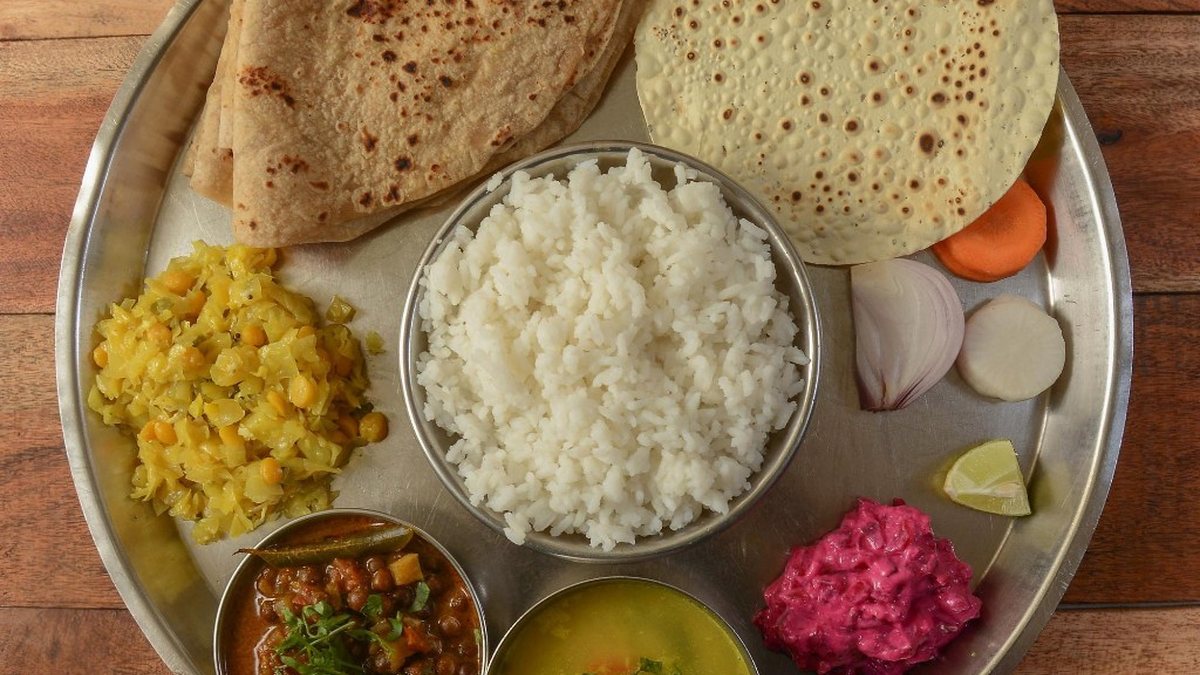
There is a particular kind of Indian diet chart that shows up in WhatsApp forwards and gym corridors. It opens with warm lemon water, replaces roti with a "multigrain wrap", puts almond milk where the doodh was, and somewhere around day four it suggests broccoli. Nobody follows it past day nine, and when it fails, the person blames themselves rather than the chart.
The chart deserves the blame. Not because Western foods are bad, but because the Indian weight problem has been measured, and the measurement points somewhere else entirely.
The roti is not the problem — these numbers are
ICMR-NIN's Dietary Guidelines for Indians 2024 contains a pair of figures that ought to be on every clinic wall in the country.
What is recommended: cereals should supply not more than about 45% of total energy, with pulses, beans, eggs and flesh foods contributing around 14–15%, total fat at or below 30% of energy, and nuts, oilseeds, milk and milk products supplying 8–10%.
What Indians actually eat: cereals contribute 50–70% of total daily energy. Pulses, meat, poultry and fish together contribute 6–9% — against a recommendation of 14%.
Read those two paragraphs again, because they contain the whole argument. The average Indian plate is not too Indian. It is too cereal-heavy and too protein-light, which is a ratio problem — and a ratio problem is fixed by moving food around the plate, not by importing a different cuisine.
The consequences are visible in the same document. ICMR-NIN records a marked increase in abdominal obesity, overweight and obesity across all age groups in both rural and urban India over recent decades, notes that about 25% of Indians are either overweight or obese, and cites National Nutrition Monitoring Bureau figures of over 31% of urban and 16% of rural adults overweight, with over 12% of urban and 5% of rural adults obese. Globally, WHO counts 2.5 billion adults living with overweight in 2022, including over 890 million with obesity, and attributes an estimated 3.7 million deaths from non-communicable diseases in 2021 to higher-than-optimal BMI.
My Plate for the Day: ICMR-NIN's own model
The guidelines come with a plate model — "My Plate for the Day" — and it is better suited to an Indian kitchen than any imported version. It asks you to source nutrients from a minimum of eight food groups, with vegetables, fruits, green leafy vegetables, roots and tubers forming essentially half the plate. The remaining space goes to cereals and millets, then pulses, flesh foods and eggs, then nuts, oilseeds and milk or curd.
Here is that model in the units your kitchen actually uses, based on the reference 2000 kcal day in the guidelines.
| Food group | ICMR-NIN reference amount | In katori terms | Where most Indian plates fall short |
|---|---|---|---|
| Vegetables | 400 g a day | Roughly 3 generous katoris of sabzi and salad across the day | Usually one small katori at dinner. This is the biggest single gap |
| Fruit | 100 g a day | One guava, one apple, or two small oranges | Often replaced by juice, which WHO counts as free sugars |
| Pulses and legumes | 85 g a day | Two full katoris of thick dal, rajma, chole or chana | Thin dal poured over rice as a gravy, not eaten as a portion |
| Milk and curd | 300 ml a day | One glass plus one katori of dahi | Mostly used in chai rather than as a protein source |
| Nuts and seeds | 35 g a day | A small fistful of peanuts, almonds, til or pumpkin seeds | Skipped entirely, or replaced by fried namkeen |
| Fats and oils | 27 g a day in the reference day; 25–30 g recommended | About 5–6 teaspoons for one person, all cooking included | Household oil tins tell the real story. This is where the deficit hides |
| Cereals and millets | Capped near 45% of total energy; at least half as whole grain | Roughly 4–5 rotis' worth across the day for a sedentary adult | Overshooting to 50–70% of energy while everything else shrinks |
The guidelines add two structural rules that do most of the work:
- Every meal should be accompanied by dal and vegetables. Not "should include some dal sometimes". Every meal.
- Prefer at least 50% of cereal or millet as whole grain, and diversify staples with millets — bajra, jowar, ragi and the smaller millets — which the guidelines note are rich in micronutrients, fibre and bioactive compounds and induce favourable changes in the gut microbiota.
Note what is not in there: no elimination of rice, no banning of roti, no imported grain, no meal-replacement shake.
Asian cut-offs: a BMI of 24 is not "fine"
WHO's general definitions are a BMI of 25 or above for overweight and 30 or above for obesity, with waist circumference as a useful additional measurement. But those thresholds were not built for our body composition.
ICMR-NIN is explicit about this. It recommends Indians aim for a BMI between 18.5 and 23 kg/m², because Indians tend to have a higher percentage of body fat at a given BMI compared with Caucasian and European populations, which leaves us at higher risk of non-communicable disease. On these Asian cut-offs:
- 18.5–23 kg/m² — the recommended range
- Over 23 to 27.5 kg/m² — overweight
- Above 27.5 kg/m² — obesity
And because fat distribution matters more than total fat, the guidelines flag central obesity separately: a waist circumference above 90 cm for men or 80 cm for women is associated with increased risk of several chronic lifestyle diseases.
Practical consequence: measure your waist. A tape costs twenty rupees, it needs no lab, and it captures the risk that a "normal" BMI can hide. If your BMI is 24 and your waist is 88 cm, an Indian guideline would not describe you as fine, whatever the international chart on the clinic wall says.
Protein: how much, from where, and the truth about powder
If the Indian deficit is protein, the obvious question is how to close it — and the obvious wrong answer is a tub of whey.
How much. WHO notes that 10–15% of total daily energy is generally sufficient to meet adult needs, which is roughly 50–75 g for a person of healthy body weight eating about 2000 calories. ICMR-NIN works through a similar arithmetic, noting that around 80 g of crude protein a day translates to approximately 60 g of quality protein meeting all essential amino acid requirements.
Where from, in an Indian kitchen. The guidelines give a genuinely elegant answer: good-quality protein comes from an appropriate combination of cereals and pulses in roughly a 3:1 ratio, plus animal-source foods such as milk, fish and flesh foods. Dal-chawal, khichdi, idli-sambar and roti-with-dal are already that combination. For non-vegetarians, a portion of the pulses can be substituted with calorie-proportionate fish, meat or eggs. And vegans eating varied diets with vegetables, beans, grains, nuts and seeds, the guidelines note, have no difficulty obtaining enough.
And the powder. One of the 17 ICMR-NIN guidelines reads, in full: obtain good-quality proteins and essential amino acids through appropriate combination of foods and avoid protein supplements to build muscle mass. The reasoning in the text is worth quoting because it is so rarely heard in an Indian gym:
Muscle protein synthesis stabilises after the typical protein intake found in a diverse balanced meal — taking protein supplements on top of normal meals is not going to build more muscle. Protein powders may also contain added sugars, non-caloric sweeteners and artificial flavouring. Whey protein is rich in branched-chain amino acids, and recent evidence suggests BCAAs may increase the risk of certain non-communicable diseases. Consuming high levels of protein, especially in the form of supplement powders, is not advisable. Protein powders are unnecessary for normal healthy life.
That is a paraphrase of ICMR-NIN's own text, not a Disha opinion. If you want more protein, the answer is a second katori of dal, an egg, a bowl of dahi, paneer, sprouts or fish — all of which cost less per gram of protein than the tub.
Three numbers to change at home: oil, sugar, salt
Most Indian households can make more progress by changing three quantities than by changing any recipe.
- Oil: 25–30 g a day per person. ICMR-NIN restricts cooking oils to this range, with the reference 2000 kcal day using 27 g. That is about five to six teaspoons — for all cooking, including the tadka, the puri and the paratha. The easiest way to manage it is to measure oil into the pan with a spoon for two weeks, which is uncomfortable and extremely informative. WHO adds the quality rule: no more than 10% of energy from saturated fat and no more than 1% from trans fat of any type.
- Added sugar: under 5% of daily energy. ICMR-NIN's tables put this at roughly 25–30 g a day for an adult, and the guidelines elsewhere advise avoiding sugar or restricting it to 20–25 g. WHO's version is free sugars below 10% of energy, with further benefit below 5% — and their definition of free sugars includes honey, syrups and fruit juices, so gud and shahad are not exemptions.
- Salt: under 5 g a day. ICMR-NIN and WHO agree: not more than 5 g of salt, equivalent to 2 g of sodium — about one teaspoon. ICMR-NIN also notes the other half of the equation, that the potassium requirement of around 3800 mg a day is easily met by eating the recommended 400 g of vegetables and 100 g of fruit, which lowers your sodium-to-potassium ratio. Eating more vegetables is a blood pressure intervention, not just a weight one.
And on ultra-processed food, the guidelines are direct about high-fat, sugar and salt foods with poor nutrient content: avoid them. That includes a great deal of what is sold as "healthy" — including diet biscuits, flavoured cereals and most protein bars.
Movement and muscle
Diet alone is the slow road, and the guidelines are specific about the alternative.
ICMR-NIN recommends that adults aged 19–60 do a minimum of 30–60 minutes of moderate-intensity aerobic activity per day on at least five days a week — or 15 minutes of vigorous-intensity activity per day on at least five days — with resistance training on at least three days a week. Its stated rationale for the strength component is that physical activity controls body weight, reduces fat mass, increases muscle mass and improves immune function.
International guidance used in the 2023 PCOS guideline sets a higher bar specifically for weight outcomes: adults aged 18–64 should aim for at least 150 minutes a week of moderate activity for general health, but around 250 minutes a week of moderate activity — plus muscle-strengthening work, ideally on two non-consecutive days — for greater benefit including modest weight loss and prevention of weight regain.
For context on how far most of us are from this: WHO reports that 1.8 billion adults do not meet the global recommendation of at least 150 minutes of moderate activity a week, and that the share of inactive adults rose by 5 percentage points between 2010 and 2022. Also from the same guidance, the most forgiving sentence in exercise science: doing some physical activity is better than none, and replacing sitting time with activity of any intensity, including light intensity, provides health benefits.
What you do not have to give up
A short list of things you can keep, each with a reason:
- Roti and rice. Capped, not cut. They are 45% of the energy budget by design.
- Ghee, in measured quantity. It sits inside the 25–30 g daily fats-and-oils allowance, and it does lower the glycemic response of the meal it is on. The NHS lists ghee among the saturated fats to eat less of — which is a portion instruction, not a prohibition.
- Dahi, chaas, paneer, eggs, fish. These are the answer to the protein gap, not obstacles to weight loss.
- Millets, in rotation. ICMR-NIN actively recommends them, and they are cheaper than most "superfoods".
- Regional food. Nothing in these guidelines requires you to abandon sambar, poha, thepla, puttu, litti or fish curry. The eight-food-group and half-the-plate rules can be satisfied in any Indian regional cuisine.
And two things worth dropping: crash diets that cut whole food groups, and the belief that weight loss requires expensive ingredients. The guidelines are explicit that they recommend foods which are accessible and affordable to the common person. That was a design decision, and it is the reason this model survives contact with an actual Indian household budget.
This is not medical advice. Weight change can be a symptom of thyroid disease, PCOS, diabetes, medication side effects and other conditions that need diagnosis rather than dieting. Energy needs vary with age, height, activity and pregnancy, so the reference amounts here are a starting model and not a personal prescription. Do not use an energy deficit during pregnancy, while breastfeeding, or alongside an eating disorder without medical supervision.
Frequently asked questions
Do I have to give up roti and rice to lose weight?
No. ICMR-NIN's model caps cereals at about 45% of total energy rather than eliminating them, and asks that every meal be accompanied by dal and vegetables. The measured Indian problem is that cereals actually supply 50–70% of daily energy while pulses and protein foods supply only 6–9% against a recommended 14%. Rebalance rather than remove.
My BMI is 24 — is that fine?
Not by Indian standards. ICMR-NIN uses Asian cut-offs where a normal BMI is 18.5 to 23, overweight is 23 to 27.5 and obesity is above 27.5. The reason is that Indians tend to carry a higher percentage of body fat at any given BMI than European populations, which raises non-communicable disease risk. A waist above 90 cm for men or 80 cm for women also signals increased risk.
Is protein powder necessary for weight loss?
ICMR-NIN's position is that protein powders are unnecessary for normal healthy life, that taking supplements on top of a balanced meal does not build more muscle, and that consuming high levels of protein particularly as supplement powders is not advisable. One of its 17 guidelines specifically says to get good-quality protein from food combinations and avoid protein supplements.
How much exercise do I need for weight loss?
ICMR-NIN recommends Indian adults do 30 to 60 minutes of moderate-intensity aerobic activity a day on at least five days a week, plus resistance training on at least three days. For weight loss specifically and to prevent weight regain, international guidance points to around 250 minutes a week of moderate activity plus muscle-strengthening work.
Sources
- ICMR-NIN — Dietary Guidelines for Indians, 2024 — the primary source for this article: the My Plate for the Day model, the 45% cereal energy cap against 50–70% actual intake, the 14% protein-food recommendation against 6–9% actual intake, the reference amounts for vegetables, fruit, pulses, milk, nuts and oils, the Asian BMI and waist cut-offs, the NNMB overweight and obesity figures, the activity recommendations and the guideline on avoiding protein supplements.
- WHO — Obesity and overweight fact sheet — the global overweight and obesity figures, the general BMI definitions and the 2021 estimate of deaths attributable to higher-than-optimal BMI.
- WHO — Healthy diet fact sheet — the 400 g fruit-and-vegetable target, the at-least-25 g fibre target, protein at 10–15% of energy, saturated and trans fat limits, free sugars limits and the under-5 g salt recommendation.
- WHO — Physical activity fact sheet — the 1.8 billion inactive adults figure and the global 150-minute recommendation.
- Recommendations from the 2023 International Evidence-based Guideline for the Assessment and Management of Polycystic Ovary Syndrome — the 250 minutes a week target for modest weight loss and prevention of weight regain, and the "some activity is better than none" framing. PubMed record.
- ICMR-NIN — Indian Food Composition Tables (IFCT 2017) — the reference tables for the nutrient content of Indian foods, if you want to check a specific dish rather than a food group.
- NHS — Eight tips for healthy eating — a plain-language checklist that maps closely onto the ICMR-NIN rules.
- NHS — How to lower your cholesterol — the saturated fat list that includes ghee, coconut oil and palm oil.
Related reads — what to read next
- Start at the top: our full Weight Management hub — how a plan is built, what gets tracked, and why plateaus happen.
- The Indian Woman's Guide to Managing PCOS Naturally — essential reading if weight has been hard to shift and your cycles are irregular.
- Glycemic Index of 50 Common Indian Foods — the food-by-food companion to this article's plate maths.
- Related hubs: PCOS and Thyroid — the two conditions most often behind weight change that will not respond to diet alone.